
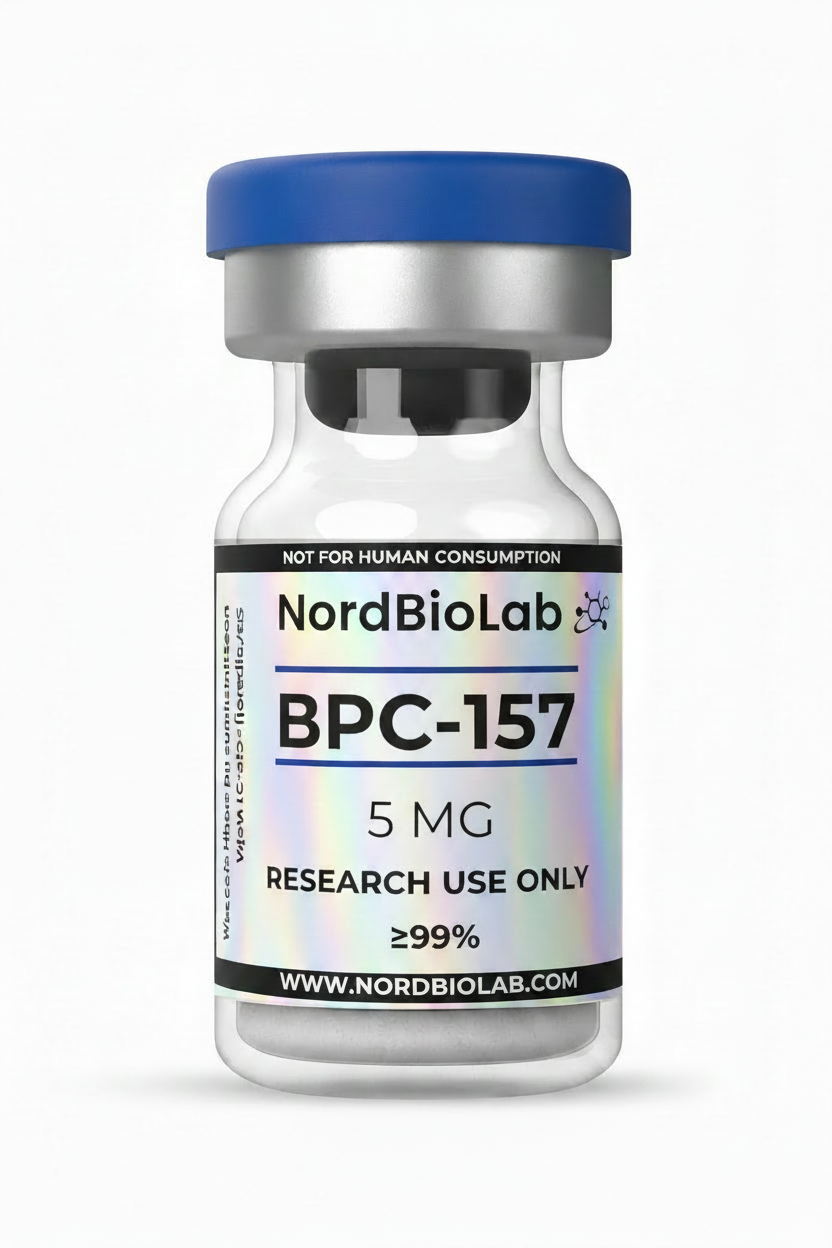
BPC-157 Peptide Vial Lyophilisate For Lab Research
5 MG
€49,00
Sale price
€49,00
Regular price
Skip to product information
This batch has been independently tested by a third-party laboratory and verified for identity, purity, and traceability.
✓ Batch-Specific COA
✓ HPLC Purity Report
✓ LC-MS Identity Confirmation
✓ Unique Batch Number
✓ Third-Party Laboratory Testing
✓ Shipped from an EU Warehouse
BPC-157 Peptide Vial Lyophilisate For Lab Research
Volume Pricing: Buy more of the same peptide product and save automatically:
3–4 vials — 3% off
5+ vials — 5% off
The discount is applied automatically in the cart.
€49,00
Sale price
€49,00
Regular price
Lab-grade purity
≥98% verified by HPLC
Fast EU shipping
Free over €100
Secure checkout
Encrypted
BATCH NR: NBLBC1007261101
View Certificate of Analysis for this batch →
BPC-157 TEST RESULTS:
Date Tested: 23.07.2026
Purity (HPLC): 99.7%
Net Weight: 6.18 mg
Molecular Identity (MS): 1418 Da — confirmed
Spectral Identity (FTIR): Confirmed match to reference standard
Date Tested: 23.07.2026
Purity (HPLC): 99.7%
Net Weight: 6.18 mg
Molecular Identity (MS): 1418 Da — confirmed
Spectral Identity (FTIR): Confirmed match to reference standard
Overview
BPC-157 is a synthetic pentadecapeptide derived from a partial sequence of a naturally occurring gastric protein. In published preclinical literature, it has been studied for its effects on tissue repair signaling, angiogenesis, inflammatory modulation, and organ-protective pathways, particularly in musculoskeletal injury, gastrointestinal protection, and wound-healing models.
Mechanism of Action (as reported in preclinical literature)
Angiogenesis & Vascular Signaling
- Formation of new blood vessels observed in injury models
- Endothelial cell migration and vascular repair
- Modulation of nitric oxide (NO) signaling
- Enhanced microcirculation in damaged tissue models
Tissue Repair & Regeneration
- Fibroblast migration and proliferation
- Tendon, ligament, and muscle repair observed in animal models
- Extracellular matrix remodeling
- Growth-factor-mediated healing cascades
Gastrointestinal Protection
- Studied in gastric and intestinal injury models
- Mucosal barrier integrity
- Inflammatory response modulation in GI tissue
- Ulcer healing in preclinical studies
Anti-Inflammatory & Cytoprotective Effects
- Reduced pro-inflammatory cytokine signaling in experimental models
- Cytoprotection against oxidative/chemical stress
- Tissue survival under ischemic conditions in models
Research Applications
- Musculoskeletal: tendon/ligament healing, muscle injury/regeneration, connective tissue repair, overuse injury recovery pathways
- Gastrointestinal: gastric ulcer healing, intestinal mucosal protection, inflammatory bowel condition models (preclinical), gut barrier studies
- Vascular/Angiogenesis: endothelial migration, microcirculation, blood vessel formation
- Systemic Injury/Recovery Models: organ protection in ischemia models, wound-healing acceleration, multi-tissue regenerative signaling
Technical Specifications
| Property | BPC-157 |
|---|---|
| Peptide Class | Synthetic pentadecapeptide |
| Amino Acid Length | 15 amino acids |
| Molecular Weight | ~1,419 Da |
| Origin | Partial sequence of gastric protein |
| Functional Role | Tissue repair and cytoprotective signaling |
| Stability | High stability in experimental models compared to many peptides |
| Primary Research Areas | Musculoskeletal, GI, vascular, wound healing |
Stability & Storage
Lyophilized: Store at ≤ -20°C; protect from moisture/light; sterile sealed conditions; avoid repeated freeze-thaw.Reconstituted: Store at 2–8°C short-term; stability depends on solvent/handling; degradation varies with temperature and sterility.
Pharmacokinetic Notes (Research Data)
Relative stability observed in harsh biological environments in experimental models; activity reported in both local and systemic injury contexts; effects mediated through signaling pathways rather than single receptor binding.
Research Use Only — Please Read
FOR RESEARCH USE ONLY. This product is intended exclusively for laboratory research by qualified professionals.
This product:
- Is not approved for human use
- Is not approved for veterinary use
- Is not intended to diagnose, treat, cure, or prevent any disease
- Is not a dietary supplement
- Must not be used in clinical or therapeutic applications
All information reflects published scientific literature and experimental research contexts only. It is not medical advice, not a dosing guide, and not intended to promote unsupervised use. Results from in vitro or animal studies may not predict outcomes in humans. Mechanisms are not fully mapped in humans.
Scientific References
-
Sikiric P. et al. Stable Gastric Pentadecapeptide BPC-157. Current Pharmaceutical Design.
2. Seiwerth S. et al. BPC-157 and tissue healing. Journal of Physiology Paris.
3. Chang C.H. et al. Experimental effects of BPC-157. Biomedicine & Pharmacotherapy.
4. Vasireddi N. et al. Emerging Use of BPC-157 in Orthopaedic Sports Medicine: A Systematic Review